
Oct 31, 2026
Four maps, no forecast
Three days before the election, the Washington Post published four Senate maps. In one, Democrats win 53 seats. In another, Republicans win 54. A third has Democrats at 55 plus an independent; the fourth is a 50-50 tie broken by Vice President Vance.
The piece is careful and well reported. It explains what would have to happen for each outcome, and what argues against it. What it never does is say which outcome is most likely. The authors state plainly that nothing they examined tells us whether the polls will miss, or in which direction.
So whatever happens on 3 November, the Post will have a map that "saw it coming." That is not a forecast. It is insurance.
I spent my career writing assessments for people who had to act on them, including for the President's Daily Brief. In that world, a paper that laid out four futures and declined to pick one would have come back with a single question in the margin: So what do you think?
What an estimate requires
The intelligence community wrestled with this problem long before election forecasting existed. In the 1960s, Sherman Kent, the father of American estimative analysis, found that policymakers read a phrase like "serious possibility" to mean anything from 20 to 80 percent. His answer was to tie words to numbers, so a judgment could be understood and later checked.
The lesson stuck. A finished assessment has three parts:
1. A judgment. What we think will happen.
2. A likelihood. How confident we are, in words tied to probabilities.
3. Indicators. What we would expect to see if we're right, and what would change our minds.
Scenario analysis, the alternative-futures technique, is a legitimate tool. But analysts use it to stress-test a judgment, not to replace one. Lay out the futures, then say which you expect and why. Skip that last step and you haven't written an estimate. You've written a list of things that could happen, and you've made yourself impossible to hold accountable.
Kent's problem is alive and well in Washington. The Cook Political Report, the capital's most trusted forecaster, still rates races in words: Solid, Likely, Lean and Toss Up. To its credit, Cook has graded itself, which none of the other sources here has done. According to the Washington Post, an internal review of 10,374 races from 1984 to 2024 found that its "Likely" ratings were right 97 percent of the time and its "Lean" ratings 94 percent. Few readers would guess that "Lean" means 94 percent. That's exactly the gap Kent warned about.
Then there's "Toss Up," the one rating that can never be wrong. It's no wonder that, as a Cook editor told the Post, campaigns "all want to be a 'Toss Up' at the end of the day."
That is the line between honest uncertainty and covering yourself. Uncertainty says "I think X, at about 70 percent." Covering yourself says "it could be X, or Y, or Z."
The hedging runs all the way down
The Post isn't the only one protecting itself. Look at the whole chain that turns voters' answers into the numbers you see on the news.
The pollsters. The Post found that in 13 of the 27 races it examined, polls agree with each other more than chance would predict. Its likely explanation: many pollsters now weight their samples to match how people say they voted in 2024. That's a defensible method, but it also means pollsters converge. No one wants to be the outlier.
Nate Silver goes further. Marist's new Maine poll showed the Democrat up 11 points for governor among registered voters, and tied among likely voters, in the same survey. Silver's leading theory is that Marist didn't believe its own Senate number, adjusted its likely-voter model toward the consensus, and broke its governor result in the process. He suggests Marist fears becoming the next Ann Selzer, the Iowa pollster President Trump sued after her final 2024 poll missed. If he's right, that's a pollster managing its own risk rather than measuring the public.
I have a confession to make here. Last week, in "Mainers Vote Against Trump but Bet on Collins," I relied on Marist's Senate numbers while questioning its turnout model, which quietly removed about five points of Democrats from the electorate even though its own enthusiasm measures favored them. The governor's result in the same poll suggests that doubt was warranted. I also found that Mainers themselves are hedging. They treat a tied governor's race as a Pingree win, yet most expect Collins to win hers, even in the Democratic-leaning 1st District, where Jackson runs strongest. Burned by Collins' 2020 upset, voters are doing what pollsters are doing: refusing to believe the Democrat's lead until they see it.
The aggregators. Then came Wedgewood Polls, a firm that admitted in October it had fabricated most of its data. Its fake surveys had been picked up by the New York Times poll tracker, FiftyPlusOne, Decision Desk HQ and Silver Bulletin. The first response from nearly everyone was the same: it didn't move our model. Silver explained that the data reached his model through the Times database, whose vetting he trusts. To its credit, FiftyPlusOne caught the fraud and admitted Wedgewood had fooled it too. But "our inputs come from someone else's vetting" is a familiar sentence. In my old business, we called it citing the source to share the blame.
The press. At the end of the chain, reporters inherit polls that have been herded, aggregated and partly outsourced. They then publish scenario pieces that cover every outcome. Each link can tell itself it acted reasonably. Together, they leave readers with no one who has actually said what they expect.
The exception: putting a number on it
In fairness, one link in the chain does take the risk. Silver's FLIPR model makes Democrats roughly 3-to-1 favorites to win the Senate. In his own voice, he goes further: Marist's Maine poll is indefensible, Hannah Pingree should win the governor's race comfortably, and he'd bet against FLIPR's own 70 percent odds for Troy Jackson. Those are judgments, with numbers attached, that can be checked on Wednesday morning.
Yes, Silver also reminds readers that a 3-in-4 favorite loses one time in four. Some will call that his own insurance policy. I don't. That is exactly what a likelihood is supposed to communicate. Kent would have recognized it. A forecaster who says 75 percent and loses hasn't necessarily been wrong. A forecaster who never says a number can't be.
The real test isn't whether anyone admits uncertainty. Everyone should. The test is whether they commit to a judgment despite it.
The scorecard
Before I grade anyone else, I owe readers my own record. On 17 October, in "The 3-Point Problem in Nate Silver's 16 October Senate Midterms Forecast," I showed that a polling miss the size of 2020 or 2024 would leave the Senate tied 50-50, with Vance breaking the tie. The Post's second scenario now makes the same point. But that piece was a warning, not a forecast. I showed how Democrats could lose without saying how likely I thought it was.
So here is my own estimate, on the record before the votes are counted. I judge that Democrats are likely to win the Senate, at about 60 percent, and that the most likely outcome is a narrow 51-seat majority. That's less confident than Silver's model, because Democrats' path still runs through rural states where polls have overstated them before, and through Maine, where Susan Collins beat her polls by a wide margin in 2020. If I'm wrong, the scorecard below will show it.
Here is what each source has actually committed to, on the record before the votes are counted. I'll fill in the last column after 3 November. Where a forecast updates daily, I'll grade the final version published before Election Day.
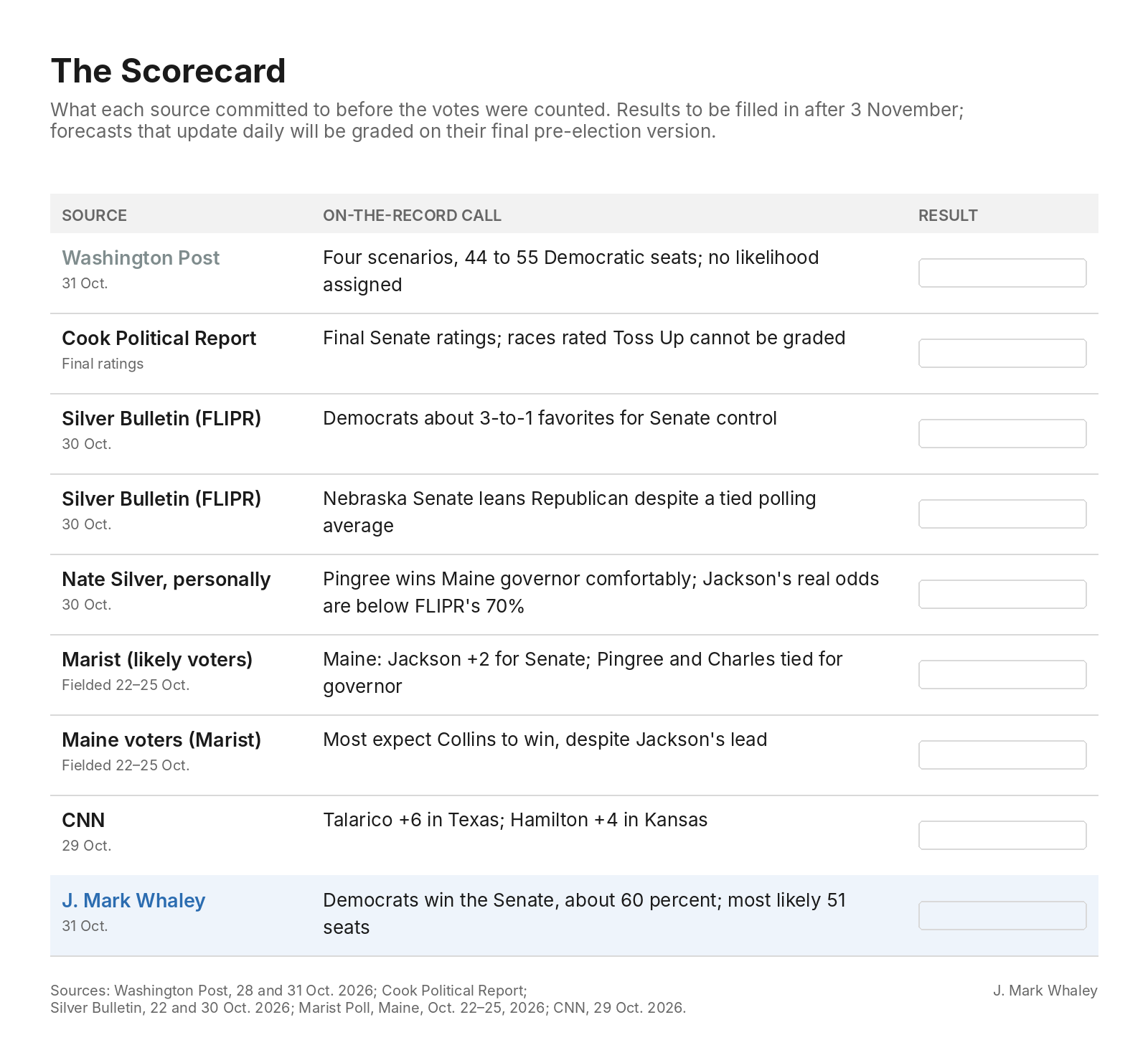
Notice which row I can't grade. Whatever happens, the Post was "right." That is the problem in a single line.
I'm not asking anyone to be certain. I spent years learning that certainty is usually a warning sign. I'm asking for what every analyst owes the people who read their work: a judgment, a likelihood, and the willingness to be found wrong.
Correction, 31 October: An earlier version described the 1st District as Jackson's home base. He is from Allagash, in the 2nd District. Thanks to a reader for the catch.
Sources
• Lenny Bronner and Eric Lau, "What if the polls are wrong about a Democratic Senate? Mapping 4 scenarios," Washington Post, 31 October 2026.
• What if the polls are wrong about a Democratic Senate? Mapping 4 scenarios. - The Washington Post https://www.washingtonpost.com/politics/2026/10/31/4-ways-polls-could-be-wrong-or-right-about-who-will-win-senate/?itid=deep_link&utm_source=webview&utm_medium=referral_top%20stories&utm_campaign=pb_2608%3Acontrol%3B
• Ian Ward, "What is the Cook Political Report, and why is Washington so obsessed with it?" Washington Post, 28 October 2026; Jennifer Agiesta, Ariel Edwards-Levy and Edward Wu, "Democrats in striking distance: New CNN polls in four states highlight party's path to Senate majority," CNN, 29 October 2026
• Nate Silver, "Fake polls are a real problem", Silver Bulletin, 22 October 2026
• Nate Silver, "The cognitive dissonance election," Silver Bulletin, 30 October 2026
• J. Mark Whaley, "The 3-Point Problem in Nate Silver's 16 October Senate Midterms Forecast", 17 October 2026
• J. Mark Whaley, "Mainers Vote Against Trump but Bet on Collins", 27 October 2026
• Axios: Election polling rocked by a new fake data scandal
• Mediaite: National polling company admits it's totally fake
• FiftyPlusOne: FiftyPlusOne just caught a pollster faking data
Could you edit to provide a link to the WaPo piece you're responding to?
>he'd bet against FLIPR's own 70 percent odds for Troy Jackson
I appreciate he can say, "the math says X, but my gut says it's not right" in a humility sense. But this says to me that Silver should spend more time reviewing his own results before putting them out there. If he can't explain why his own numbers are reasonable, how can we feel comfortable trusting them?
Troy Jackson is from the 2nd district in Maine.