
"As Maine goes, so goes the nation." — Old American political saying
Bottom Line
Troy Jackson leads Susan Collins 49% to 47% among Maine likely voters in Marist's October 22–25 poll. That lead is statistically meaningless on its own, but the poll underneath it tells a more interesting story. Mainers dislike both candidates, they are voting largely against President Trump, and most of them still expect Collins to win. Whether Jackson's narrow lead holds depends heavily on an assumption Marist made about who will turn out, and the poll's own data give reasons to question that assumption.
A 2-Point Lead in a 13-Point Range
Marist surveyed 1,449 registered voters, but the headline number comes from likely voters, and that estimate is much less precise. Marist reports a margin of error of ±6.6 points for likely voters, against ±4.1 for registered voters. The reason is in the fine print: rather than screening out unlikely voters, Marist weights every respondent by their estimated chance of voting. That method is sound, but it costs precision. Although Marist interviewed 1,449 Mainers, its adjustments make the likely-voter result about as precise as a purely random sample of roughly 220 people.
The margin of error also applies to each candidate's share, not to the gap between them. The uncertainty on the lead is roughly double. A 2-point Jackson lead is consistent with anything from a comfortable Collins win to a comfortable Jackson win.
That does not make the poll useless. Marist is one of the most reliable pollsters in the business, and its result is in line with the other recent Maine polls: Beacon/Shaw and Trafalgar both show the race tied. Every credible measure says this race is a dead heat. The crosstabs are where this poll's value lies. They show why the race looks the way it does.
Unpopular but Leading
Jackson is leading without being liked. Only 39% of likely voters view him favorably, while 49% view him unfavorably and 11% are unsure. Collins is underwater too, at 44% favorable and 53% unfavorable. Yet Jackson wins 49% of the vote, 10 points more than his favorable rating, while Collins wins 47%, about 3 points above hers.
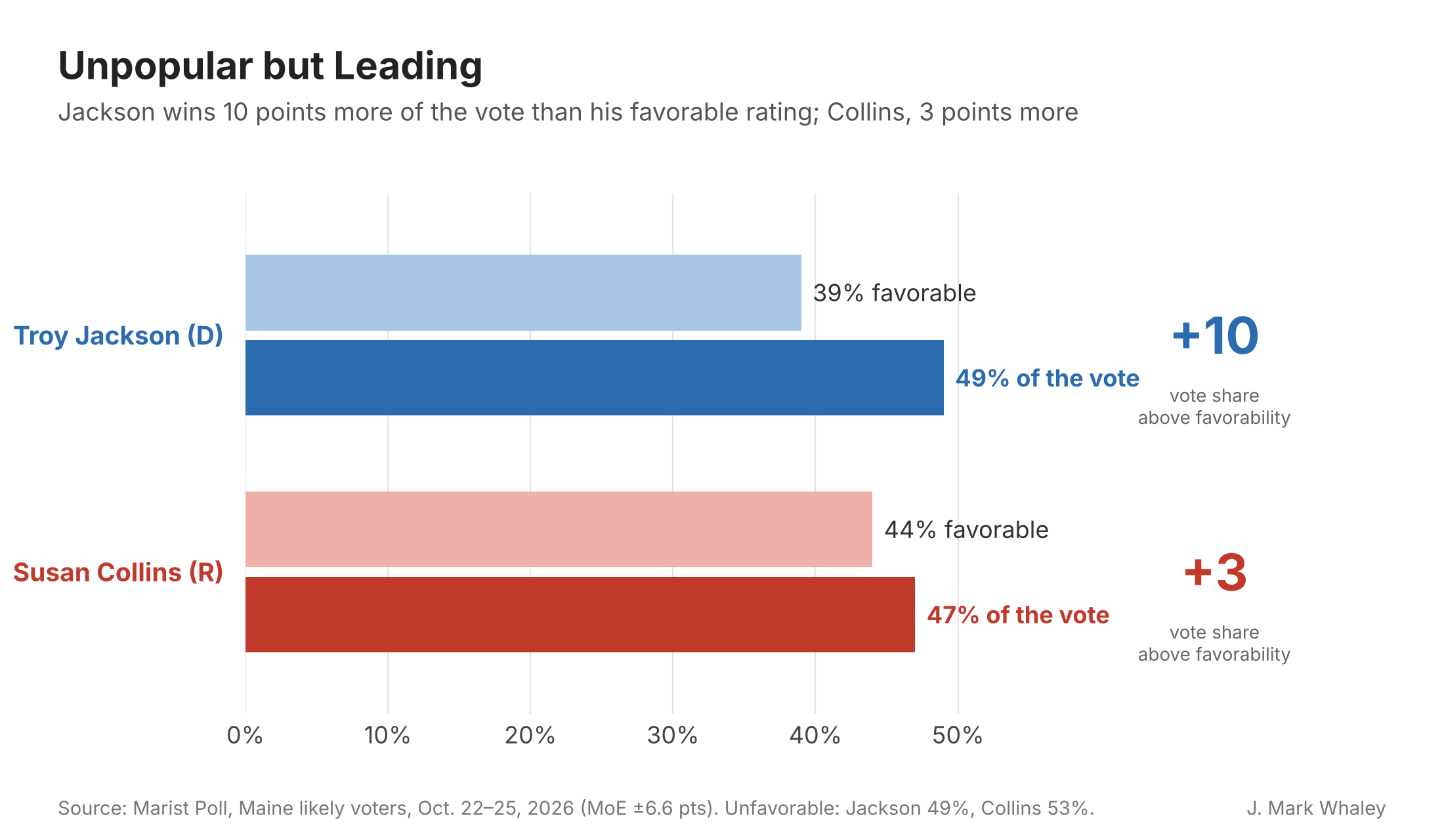
The gap is widest among independents, who make up 35% of Marist's likely electorate. Only 34% of them view Jackson favorably, but he wins them 50% to 41%.
The explanation is the president. Trump's job approval in Maine stands at 42%, with 58% disapproving, and intensity runs heavily against him: 53% strongly disapprove, while only 25% strongly approve. Asked about their vote for Congress, 41% call it mostly a vote against Trump, compared with 16% who call it a vote for him. Among independents the ratio is 46% to 9%.
Jackson's support, in other words, is anti-Trump first and pro-Jackson second. Collins, by contrast, outruns her party's leader. Only 32% of independents approve of Trump, but 41% vote for Collins. That 9-point margin is her crossover appeal, the same appeal that carried her in 2020.
Voting for Jackson, Betting on Collins
Asked who will actually win, regardless of whom they support, 58% of likely voters name Collins and only 40% name Jackson. Even 19% of Democrats expect Collins to win, as do 58% of independents.
The most telling number comes from Jackson's own stronghold. Maine's 1st District backs him 62% to 37%, yet only half of its voters expect him to win. In the 2nd District, 67% expect Collins to prevail.
Voters are not reading the race as a generic contest. In the governor's race, which is tied at 44%, 63% expect Democrat Hannah Pingree to win. Mainers treat an even race as a Democratic win, except when Collins is on the ballot. That is the residue of her history. Polls showed her trailing in 2020, and she won by more than 8 points.
Voters' expectations are not a forecast, but they may still matter. A Jackson voter who doubts he can win is a voter who might stay home.
The remaining persuasion is small. Both candidates' supporters are locked in: 68% of Jackson voters and 69% of Collins voters back them strongly, and fewer than 1% say they might switch. Only 3% are undecided. Democrats lead the generic congressional ballot 52% to 47%, which suggests most of the undecided are Democratic-leaning voters who have not warmed to Jackson. Collins draws exactly her party's 47%. Jackson's ceiling is about 52% if he can bring home his own party's voters.
The Turnout Question
The single biggest judgment in this poll is Marist's estimate of who will vote. Among registered voters, the sample is 36% Democratic, 31% Republican, and 30% independent. After Marist applies its likely-voter weights, Democrats fall to 31%, Republicans stay at 31%, and independents rise to 35%. Five points of Democrats effectively disappear.
That runs against the usual midterm pattern, in which the party out of the White House is the more motivated. It also sits uneasily beside the poll's own enthusiasm measures:
Voting habit: 82% of Democrats say they always vote, compared with 80% of Republicans and 61% of independents.
Sense of duty: 86% of Democrats call voting a duty rather than a choice, compared with 65% of Republicans.
Campaign contact: 82% of Democrats have been contacted by a campaign, party, or civic group, compared with 69% of Republicans.
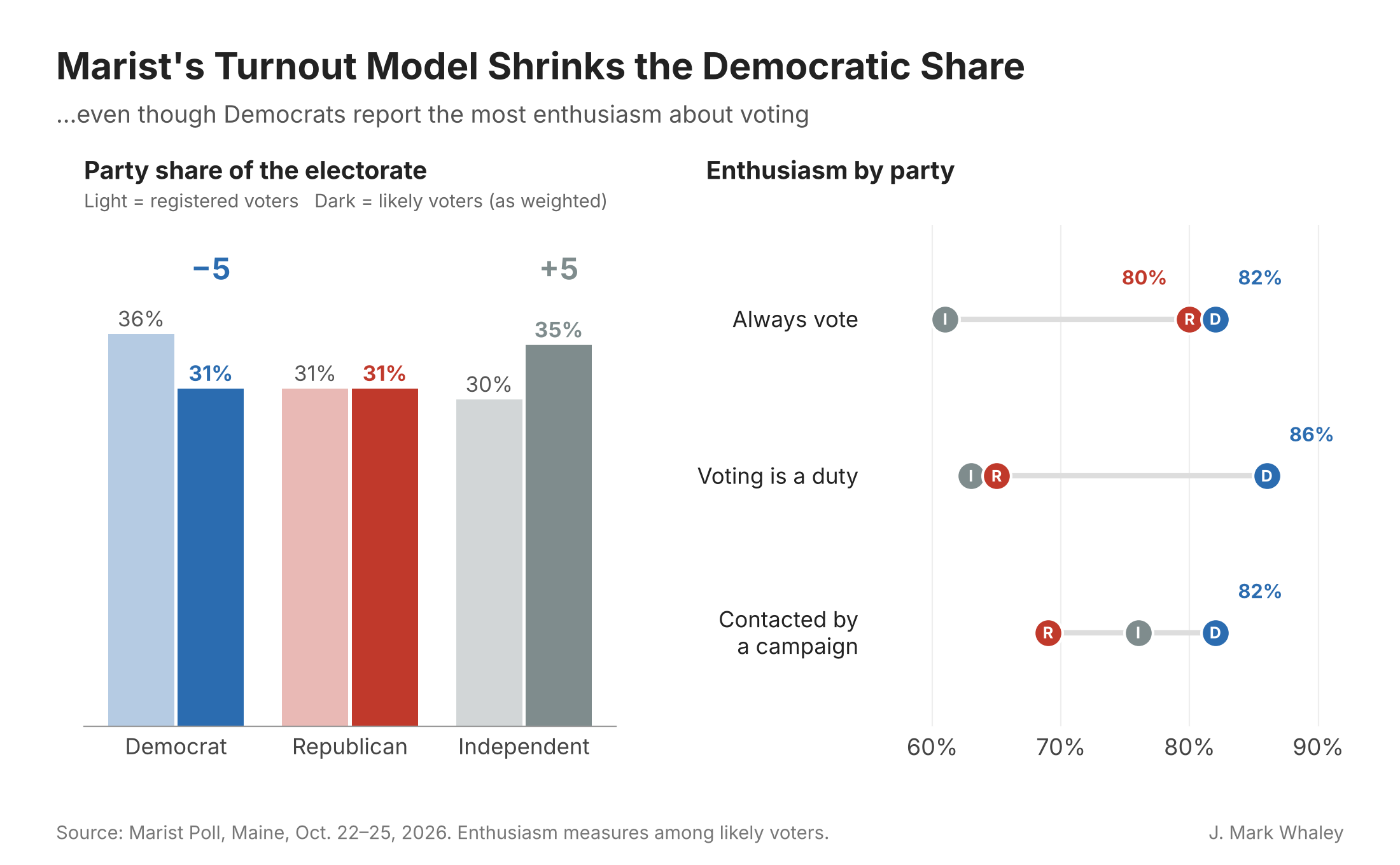
The partisan mix matters because Maine voters are almost perfectly loyal: Jackson and Collins each win 99% of their own party. The race therefore turns on how many Democrats, Republicans, and independents show up. If Democrats turn out at anything like the rate they claim, Jackson's position could be several points better than this poll shows.
Marist may well be right. People routinely overstate how likely they are to vote, and Marist's model probably draws on voters' actual turnout records, a sturdier guide than what they tell a pollster. Still, the gap between its turnout assumption and its own enthusiasm data is a question worth asking. That uncertainty matters more than the 2-point headline.
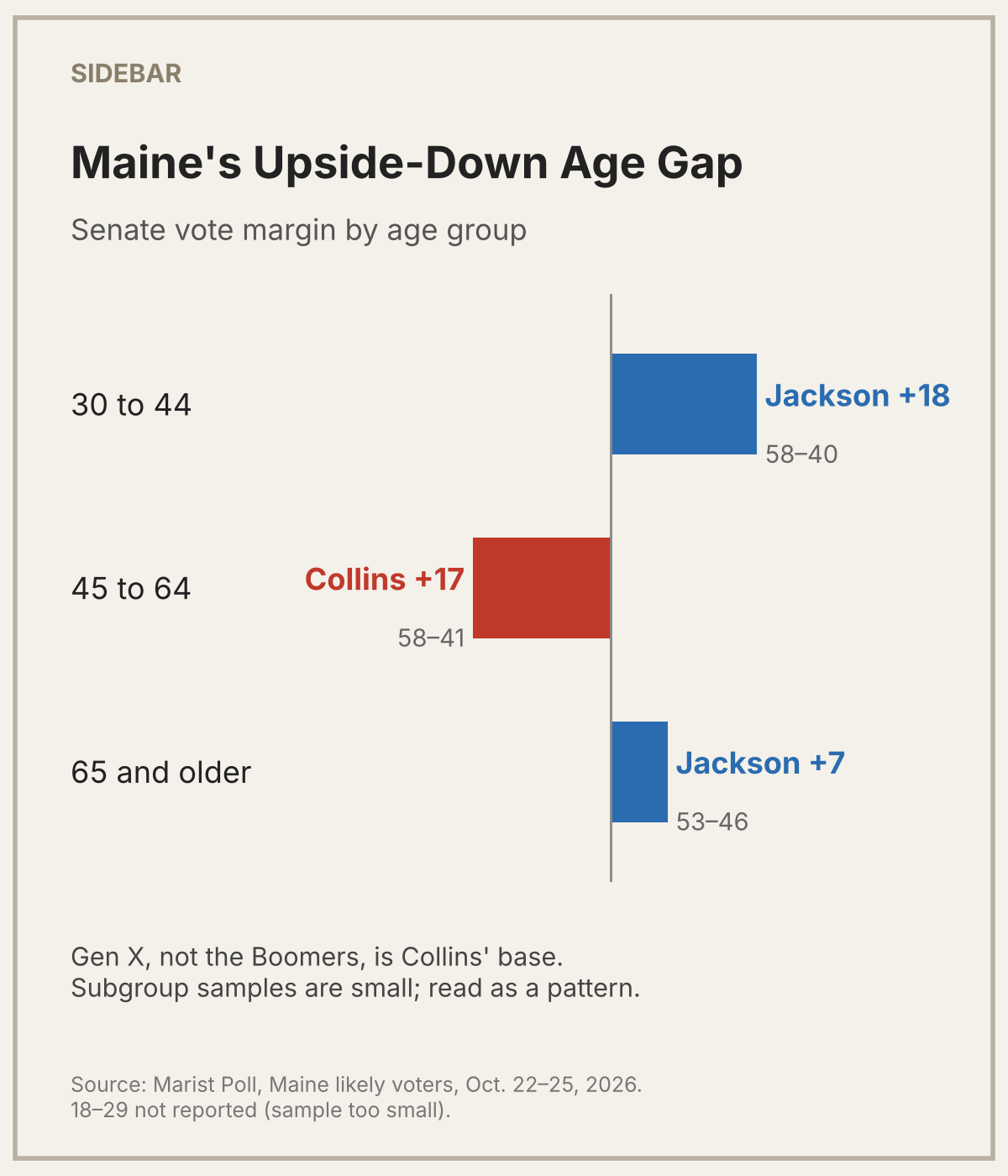
In most states, the oldest voters are the most Republican. Not in Maine, according to Marist.
Voters 65 and older back Jackson 53% to 46%.
Voters 45 to 64 back Collins 58% to 41%.
Voters 30 to 44 back Jackson 58% to 40%.
Generation X, not the Baby Boomers, is Collins' base, and it is also Trump's best generation in Maine, with 49% approval. The governor's race shows the same pattern. Subgroup samples are small, so treat the exact numbers with caution, but the shape is striking.
What to Watch
Democratic turnout in the 1st District. If Democrats vote at the rates they claim, Marist's model understates Jackson.
The 3% undecided. If they behave like the Democratic voters they resemble, Jackson approaches 52%. If they share their neighbors' doubts about him, the race stays a coin flip.
Collins' margin in the 2nd District. She leads there 55% to 38%. Anything less leaves her without a path.
Bottom Line
Maine voters are sending a message against Trump, and Jackson is the vehicle for it, not the reason. Collins remains personally unpopular, yet she holds her party's vote and keeps enough independents to stay within reach. Most Mainers think she will win again. Whether they are right depends less on persuasion than on turnout, and on whether Marist's assumptions about who votes match the electorate that actually shows up on November 3.
The old saying held that as Maine goes, so goes the nation. It has not been reliable for nearly a century, but this year it may come true in a narrower sense. Maine is one of the seats Democrats most likely need to win the Senate majority. If Mainers are betting wrong, the Maine Senate race could decide control of the chamber.
Source: Marist Poll of 1,449 Maine registered voters, conducted October 22–25, 2026. Likely-voter results carry a margin of error of ±6.6 percentage points.
"Although Marist interviewed 1,449 Mainers, its adjustments make the likely vote result about as precise as a purely random sample of roughly 220 people."
Can you elaborate on the math behind this? It sounds like you are comparing polling error calculations between two possible models.
Collins is an asslicking traitor and a coward. Like most republicans.