
Polling guru Nate Silver updated his predictions for the Senate midterm races on 16 October, giving Democrats a 74.6 percent chance of winning a majority. His model, which he ran 40,000 simulations to get his predictions, now projects a 52-48 Democratic majority built on victories that almost no one would have expected a year ago: Ohio, Maine, Texas, even Kansas.
But these predictions rests on a handful of races where Democrats lead by about three points. By shifting these polls three points toward the GOP candidates — about the degree of polling misses in both 2020 and 2024 — we’d see the Democrats end up with exactly 50 seats, meaning Vice President JD Vance would cast tie-breaking votes and Republicans would stay in control of the Senate.
What Silver's model says
On its face, the Silver’s forecast is good news for Democrats. His model rates the puts the average outcome at 52 Democratic seats, a net gain of five.
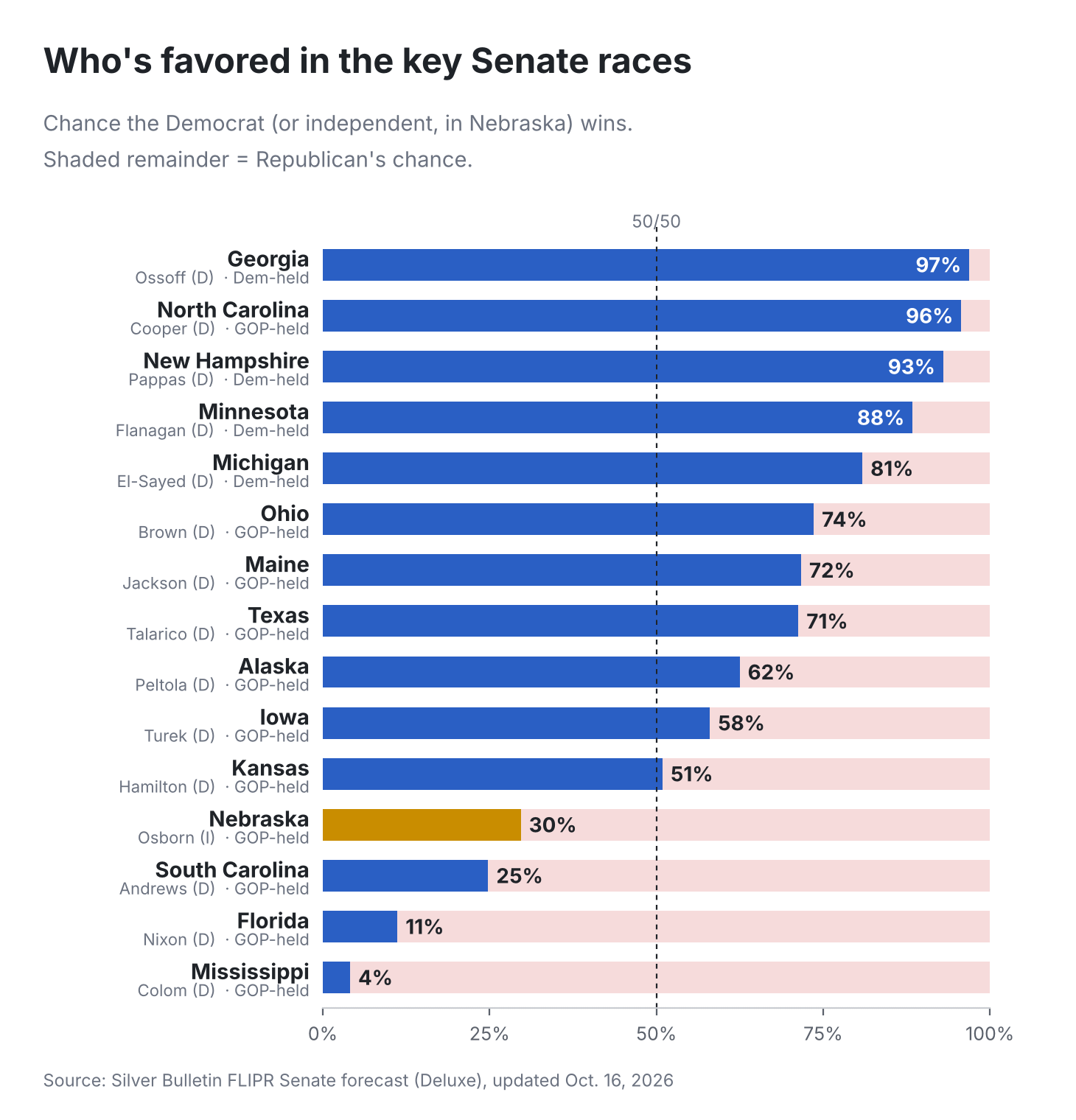
The near-certain gains and holds come first. Ossoff in Georgia (97 percent), Cooper in North Carolina (96 percent), and Pappas in New Hampshire (93 percent) are all heavy favorites. Michigan's open seat leans to El-Sayed at 81 percent.
Then comes the cluster that decides everything. Brown in Ohio (74 percent), Jackson in Maine (72 percent), and Talarico in Texas (71 percent) are each favored, but only modestly. Alaska (63 percent), Iowa (58 percent), and Kansas (51 percent) are closer to coin flips. Republicans are favored in Nebraska, where Pete Ricketts has a 70 percent chance against independent Dan Osborn, and Graham narrowly in South Carolina.
How Democrats got here
The polling trend lines tell a consistent story: Democratic candidates have held steady while Republicans have lost ground since late summer. The gains consistently come less from Democratic surges than from Republican erosion.
In Alaska, Mary Peltola has stayed near 48 percent while Dan Sullivan slid from about 47 to 44 since late September. In Ohio, Sherrod Brown has hovered around 48 percent for months while Jon Husted fell from 47 to a low near 43.5. In Kansas, Roger Marshall led by four points in August; Democrat Hamilton overtook him around October 1. Even Texas fits this pattern, with Ken Paxton unable to climb past about 46 percent.
South Carolina shows how unusual this cycle has become. Lindsey Graham died suddenly in July, and his sister Darline Graham, who had never held office, was appointed to the seat and then won the Republican nomination. She now leads Democrat Annie Andrews by under two points in the polling average, and Silver gives Andrews a one-in-four chance in a state Democrats last won in 1998.
The cold water: a 3-point problem
Most of the Democratic leads fall inside the range of a normal polling miss, and the misses of recent cycles have run in one direction — toward the GOP.
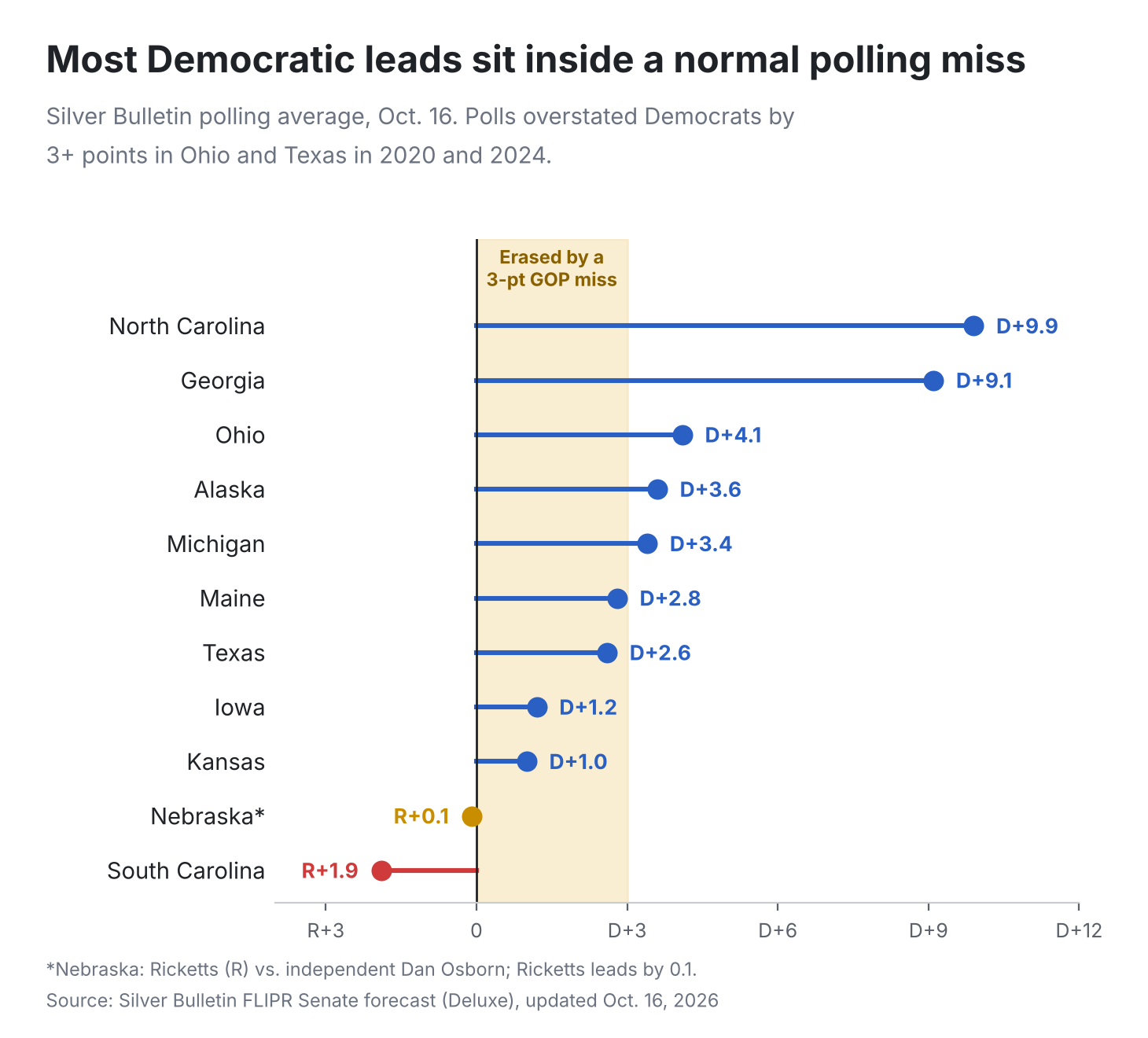
The pattern is hard to ignore. In Ohio in 2022, polls showed Tim Ryan close to JD Vance; Vance won by six. Texas polls had Ted Cruz up three or four in 2024; he won by about eight and a half. And in Maine in 2020, Susan Collins trailed in nearly every poll, then won by almost nine.
Now apply a uniform three-point shift toward Republicans to today's polling averages. North Carolina, Ohio, and Alaska stay Democratic, though Ohio's lead shrinks to about one point and Alaska's to under one. Michigan survives by less than half a point. Maine, Texas, Iowa, and Kansas all flip. Democrats finish with 50 seats, and Republicans keep control on Vance's tiebreaking vote.
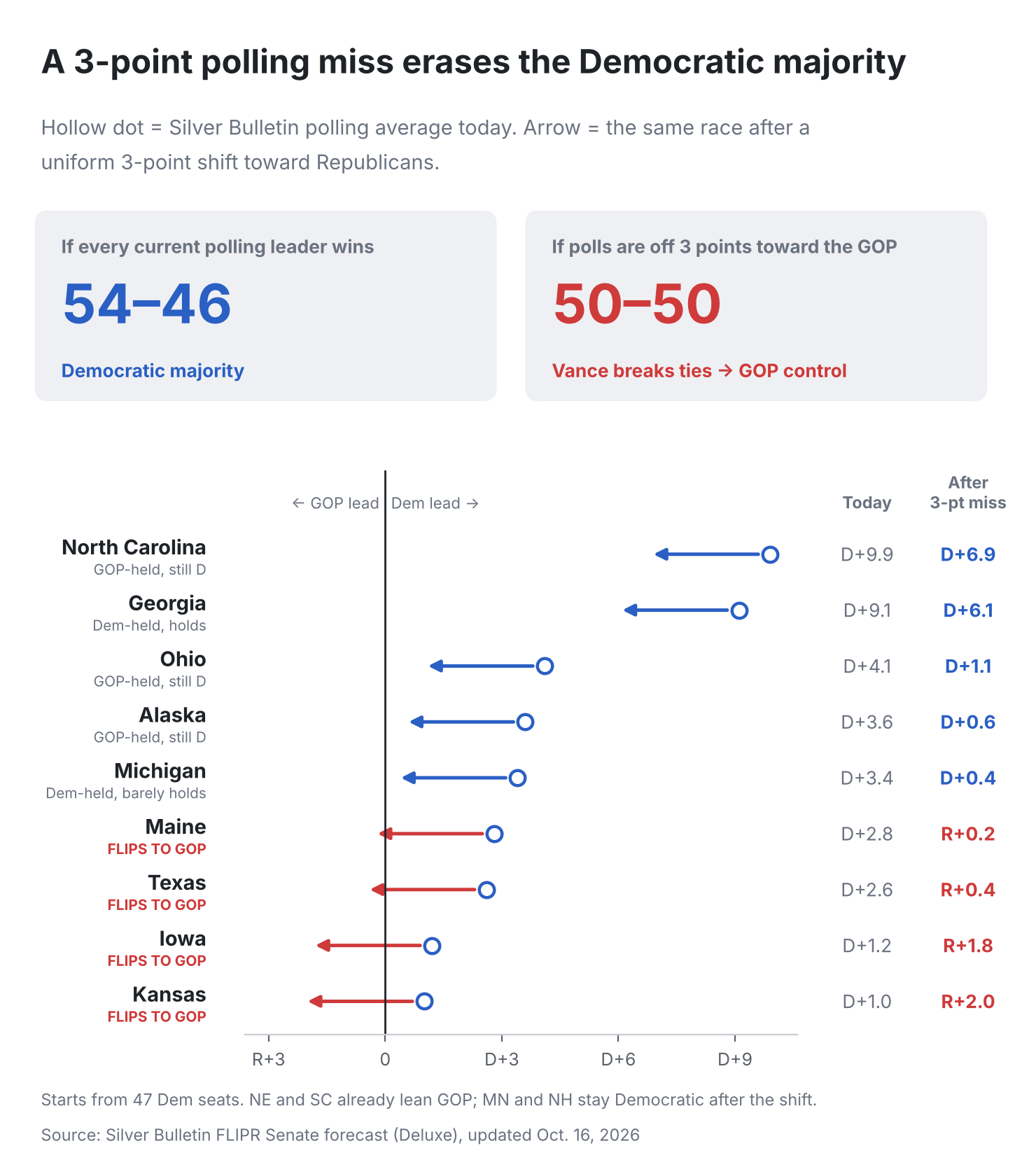
One note on the numbers: if every current polling leader won, Democrats would reach 54 seats, higher than Silver's average of 52. Silver's figure is lower because it accounts for the real chance that some leaders lose anyway. Even the optimistic version, in which every leader wins, sits one polling miss away from a 50–50 Senate.
The math of control
Democrats need a net gain of four seats, and the fourth one sits at roughly a three-point lead. Rank the Republican-held seats by Democratic win chance and the order is North Carolina, Ohio, Maine, then Texas: the 51st seat. Alaska, Iowa, and Kansas are the cushion.
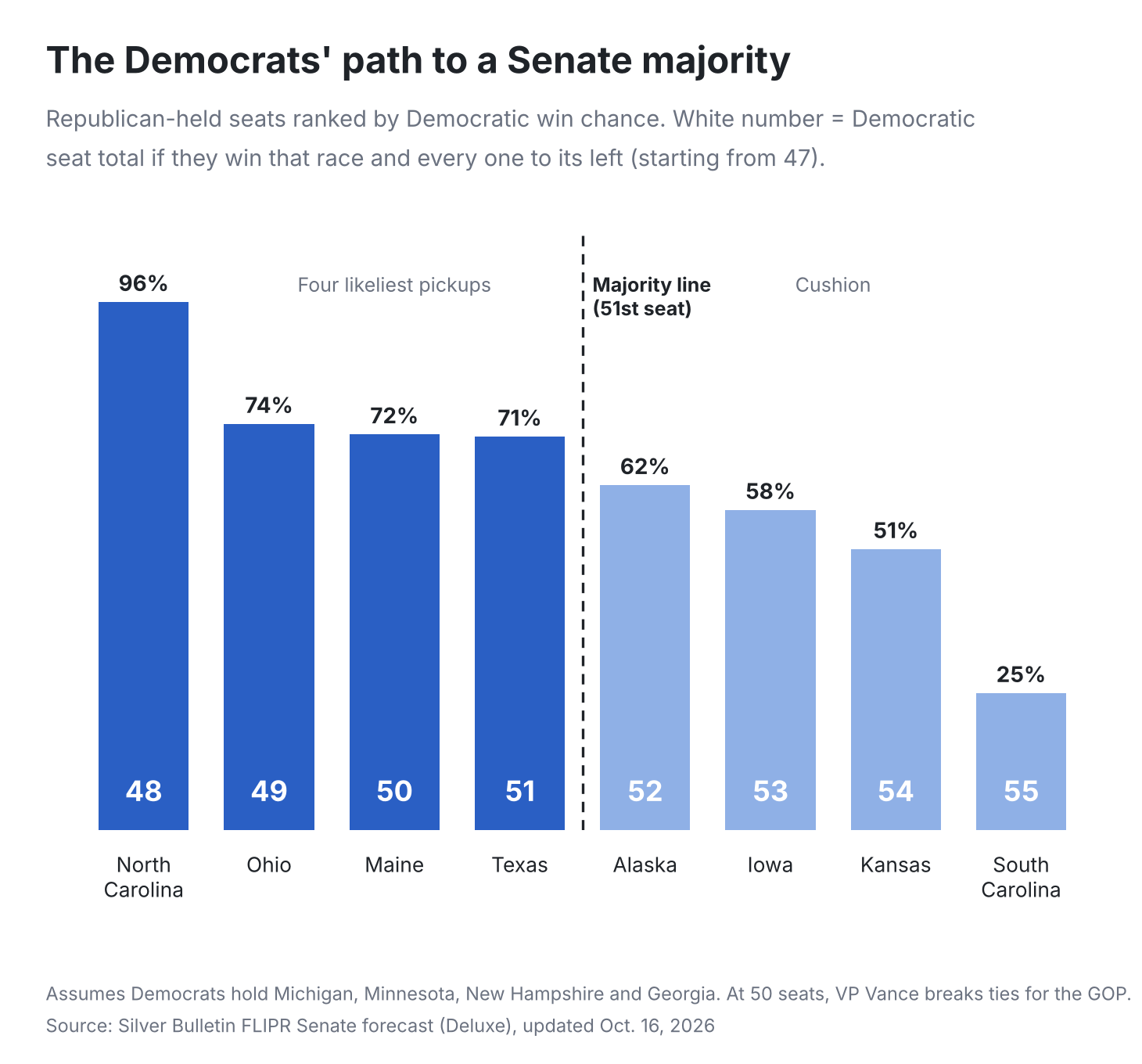
Silver’s tipping-point analysis makes the same point from another angle. No single race decides control. Maine and Texas each have a 12 percent chance of being the decisive seat, Ohio 11 percent, and Iowa and Michigan 10 percent each. Add Kansas and Alaska, and seven races share about 71 percent of the chance of deciding the Senate.
Silver’s Voter Power Index adds a human dimension. A single vote carries the most weight in Alaska (19.4) and Maine (12.2), where small electorates meet close races. Texas ranks near the top as a tipping point yet scores only 1.0, because millions of voters share that influence. In my home state of Nebraska, the index is 3.9: one vote in Lincoln counts roughly four times as much as one in Houston.
In fairness to Silver
None of this means Silver has missed anything. His 74.6 percent already accounts for polling error; that is what the ranges in his race-by-race charts represent, and why a three-point Alaska lead translates into only a 63 percent chance. The uniform three-point shift used here is also a simplification, since real polling misses vary from state to state.
The point is what his number means in practice. A 25 percent chance is not a long shot, and Silver knows this better than anyone. His final 2016 forecast gave Donald Trump about a 29 percent chance, and Trump won. Silver did a lot of explaining afterwards to make his point that an outcome shouldn’t have surprised anyone as a a more than one in four chance is going to happen every four or so times statistically
The Democrats' advantage, then, is real but conditional. It depends on the polls being roughly right in Ohio, Texas, and Maine, the very states where they have recently been wrong in the same direction.
What to watch
Three markers over the next two and a half weeks will show whether the forecast holds.
1. Texas polling. The two most recent heavily weighted polls both showed Paxton up a point. If that tightening continues, Texas leaves the Democratic column and the Dems lose their 51st seat.
2. South Carolina’s early vote. In-person early voting begins Monday, October 19. South Carolina doesn’t register voters by party, so the totals will show turnout levels, not who is ahead; the useful comparison is turnout in Republican-leaning versus Democratic-leaning counties.
3. Election night’s first signal. South Carolina’s polls close at 7 p.m. Eastern. If Andrews is running close there, the Democratic leads in Ohio, Texas, and Iowa are probably real. If Graham wins comfortably, settle in for a long night.
Silver’s model says Democrats are favored. The history of the last two cycles says the model’s favorites are standing on thinner ice than 74.6 percent suggests. Caveat qui praedictiones examinat.
Source: Silver Bulletin FLIPR 2026 Senate forecast, updated October 16, 2026.
Another early sign is KY-06. If the Democrat wins (early poll closing) the D advantage is real and 52 is a minimum.
Question - I'm curious about the 3 point polling error shift you cite. What's the basis for this? Of course polls have an error range, but I don't personally have a sense for how reasonable a 3pt miss really is.
I do think that if one state's polling is off, I would expect other states' to be off in the same direction. So your uniform shift approache seems reasonable in application, I'm just wondering about the 3pt assumption specifically.
>A 25 percent chance is not a long shot, and Silver knows this better than anyone... Silver did a lot of explaining afterwards to make his point that an outcome shouldn’t have surprised anyone
It mathematically shouldn't have, but I do critique Mr. Silver for the way he presented his analysis, and his tone in responding to the understandable public response. It's just a fact that the average person is bad at math, and statistics in particular are unintuitive for many. I think the kind of analysis you're doing is important to temper over reliance on any given model.