
A newspaper's comment section is usually treated as an afterthought — a bit of digital plumbing bolted onto the bottom of a story. But look closely at how the New York Times and the Washington Post handle theirs, and a different picture emerges. These are not neutral engineering choices. They are expressions of institutional philosophy: what each paper believes a newspaper owes its readers, and what kind of relationship it wants with the public that pays for it.
The Times treats comments the way a maître d' treats a dining room: a limited number of seats, a dress code, and a host deciding who gets in. The Post, at least until recently, has treated them more like a town square: open by default, policed for the worst behavior, but otherwise left to sort itself out. Both models are defensible. Both come with costs. And in the last two years, one of them has been tested in a way its architects never intended.
The Times: curation as house style
The Times has never tried to hide that its comment sections are curated, not democratic. For years, comments were open on only a small slice of the paper's daily output — historically around one in ten articles — because the Times insists on human moderation rather than automated filtering as the primary gate. A community desk of more than a dozen staffers reviews thousands of comments a day, reading for tone as much as for rule-breaking. The paper has experimented with machine-learning tools to help triage the volume, but it has resisted handing the actual judgment calls to an algorithm the way many outlets have.
On top of that moderation layer sits a curation layer: "NYT Picks," a badge awarded by staff to comments judged the most thoughtful, alongside a separate "Reader Picks" tab driven by upvotes. The effect is a comment section that reads less like an open debate and more like a letters page — a format the Times essentially invented and has been reluctant to abandon, digitally, in the underlying instinct.
That instinct produces a real structural side effect: because moderation happens in shifts concentrated on the East Coast workday, commenters in the Mountain and Pacific time zones routinely find threads closed, or their comments queued for review long after the conversation has moved on. It's not a policy anyone designed on purpose. It's a byproduct of treating comments as a small, hand-tended garden rather than an open field — and it reveals something true about the Times' priorities. Consistency of tone matters more than equal access. The comment section is meant to protect the authority of the article above it, not to compete with it.
The exclusionary quality of that system isn't only a matter of geography, either — it shows up in individual attempts to participate, too. This writer has submitted about half a dozen comments on Times articles over the years — real engagement with the reporting, not venting — and only one was ever approved; another was cut off entirely when the comment window closed before it could be submitted. The one approved comment only sharpened the contrast: a brief, offhand remark dashed off in seconds, about adult children quitting Facebook, sailed through with no friction, while the other, more substantive submissions sat rejected for reasons the Times never explains. Neither experience is evidence of bad faith; it's the predictable shape of a system built around a narrow, curated conversation. But it's a cost worth naming: a "quality-first" model filters out some of the very readers it claims to be selecting for, simply because the gate is narrow and the clock runs out.
The Post: openness as identity
The Washington Post has historically taken the opposite bet. By its own account, the paper offers comment sections on nearly all of its articles, moderated by a standing team rather than a small curatorial desk, with lighter editorial intervention and more tolerance for messy, contentious threads. Where the Times treats comments as content to be selected, the Post has tended to treat them as a feedback channel — noisier, less filtered, but closer to a genuine cross-section of what readers think.
This isn't incidental. It fits a broader identity the Post has cultivated as the paper of record for a city built on argument — a place where the comment section functions less like a curated salon and more like a Sunday-shows greenroom that never quite ends. Openness has been a competitive differentiator, a way of signaling that the Post wants engagement and debate rather than merely approval.
When the philosophy gets tested
That openness collided with something else entirely in 2025, and the collision is the most interesting thing to happen to either paper's comment section in years.
In October 2024, owner Jeff Bezos blocked the paper's editorial board from endorsing a presidential candidate, breaking decades of precedent — a decision that preceded roughly 300,000 subscription cancellations by Election Day. Two months later, in January 2025, Pulitzer Prize-winning editorial cartoonist Ann Telnaes resigned after editorial page editor David Shipley declined to run her sketch of Bezos and other tech and media executives kneeling before an incoming President Trump. Shipley said the call was about avoiding repetition with other scheduled content, not the cartoon's target; Telnaes wrote that in her time at the paper she had never before had a cartoon killed over who she'd aimed her pen at. Then, in February 2025, Bezos went further still: he directed the Opinion section to write only in defense of "personal liberties and free markets," explicitly stating that dissenting viewpoints on those subjects would be left to other publications. Shipley resigned from that role as well, within hours of the announcement. Longtime columnists and editors followed him out the door over the following weeks, several publicly, and subscriber cancellations continued climbing into the hundreds of thousands. That fall, opinion columnist Karen Attiah was fired after commenting publicly on the killing of conservative activist Charlie Kirk. A labor arbitrator ordered her reinstated nearly a year later, ruling that the Post "did not have good and sufficient cause" to terminate her — a sign that the pressure on dissenting opinion voices was being felt, and contested, well past the initial Opinion overhaul. Whether or not one agrees with Bezos's decisions, the sequence created a rare moment when the kind of dissent that Opinion and the cartoon desk could no longer freely accommodate found virtually its only remaining outlet in the Post's open-comment sections — accessible through the paper's website and its Android and iOS apps — inside the digital edition itself.
What makes this relevant to a piece about comment sections specifically is where readers went to register their fury: into the Post's own still-open comment threads. Reporting at the time put the volume of reader response across the publisher's note, related news stories, and opinion pieces at well over 100,000 comments — a real-time demonstration of exactly the "public square" dynamic the Post's open-comment philosophy was built to enable. The infrastructure did what it was designed to do. Readers showed up, argued, and were not gatekept out.
The Telnaes episode gave that dynamic a longer half-life than a single news cycle. The Post kept publishing editorial cartoons after her departure, cycling through several cartoonists rather than replacing her with one successor — and the comment threads under those cartoons have kept surfacing the same sentiment, regardless of which cartoonist or subject is on that day's page. One representative example: a September 2026 thread under a cartoon on an unrelated, non-political subject carried a comment reading simply "I really miss Ann Telnaes…", quickly drew 33 upvotes and multiple reply threads — ordinary engagement numbers for that comment section, but notable for how detached the sentiment was from the cartoon it was ostensibly responding to.
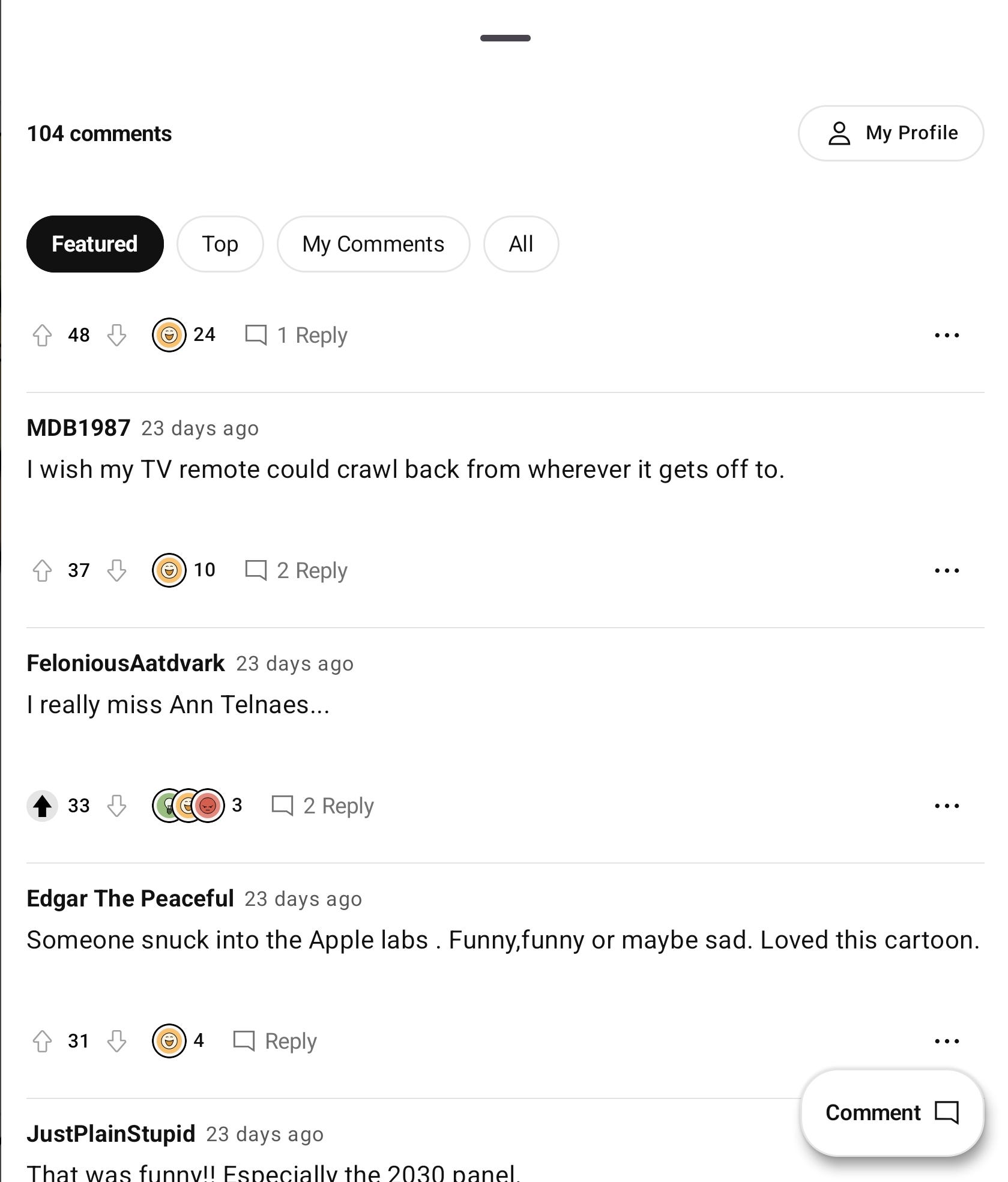
Screenshot by author, 4 October 2026
The sentiment isn't confined to that one thread, either. Roughly two weeks earlier, in a comment thread under a political cartoon about the Trump administration, a different reader wrote "Bring back Ann Telnaes!!" and drew 29 upvotes; two weeks apart, on two different cartoons by two different hands, on two different subjects — one political, one not — separate readers reached for the same two words. The absence, not any particular successor, is what keeps drawing comment. That's a small but pointed data point: readers are using the Post's own open-comment architecture to protest a decision the architecture itself had nothing to do with, which is exactly what an open forum is for.
There's a symbolic layer to this, too. The Post's masthead motto, "Democracy Dies in Darkness," predates Bezos's tightening of the Opinion pages by eight years, and despite widespread reporting in early 2025 that the paper was retiring it, company spokespeople insisted at the time that it remained the paper's public-facing tagline — it still anchors the Post's official social media presence today. But its visibility in the place that matters most for this argument — the digital editions where readers actually encounter stories and submit comments — has quietly receded. Opening the Post's Android app today surfaces no version of the motto anywhere on the front screen; the masthead reads simply "The Washington Post," full stop.
J. Mark Whaley served as a senior analyst on African politics in the U.S. intelligence community. He holds a master’s degree from the Fletcher School, where he specialized in diplomatic history and strategic studies.

Android Washington Post app w/o motto. Screenshot by author, 4 October 2026.
Screenshot of Android Washington Post app showing lack of motto taken by author 4 October 2026
Whatever the company's official position on the slogan, the digital doorway through which most readers now enter the paper has stopped saying it out loud. What changed alongside that fade was a separate, internal-only mission statement, "Riveting Storytelling for All of America," explicitly framed as a staff rallying cry rather than a public replacement. That combination — a motto quietly disappearing from the app's front door while an anodyne internal slogan takes its place backstage — left an irony sitting in plain view, and commenters did not let it pass. On the paper's own coverage of the endorsement decision, one heavily upvoted comment mockingly turned the masthead motto back on its owner, treating "democracy dies in darkness" as a description of Bezos's conduct rather than the warning he'd once championed. For a moment, the open comment section became the one place inside the institution where the gap between the Post's stated values and its owner's actions could be pointed out publicly, under the paper's own logo, without an editor's sign-off.
But the episode also exposes the tension sitting underneath that openness. The same owner who left the comment sections structurally untouched was simultaneously narrowing, by fiat, what viewpoints the paper's own opinion writers were permitted to publish. A comment section can be a genuine public square only as long as the institution around it tolerates dissent elsewhere too. Bezos's intervention didn't touch the comment infrastructure directly, but it raised an obvious question for anyone watching closely: how much longer does an ownership structure willing to police its own columnists leave the reader threads alone? The Post's comment policy, in other words, may currently be less a stable philosophical commitment than a holdover from an earlier era of the paper — one that hasn't yet been reconciled with the more centralized, owner-driven direction the rest of the institution is visibly taking.
Two philosophies, two kinds of risk
Set side by side, the two approaches carry mirror-image risks. The Times' curated model protects tone at the cost of access — it is, by design, exclusionary, and its time-zone blind spot is a small but telling artifact of an editorial culture built around a New York workday. The Post's open model protects access at the cost of tone — it is, by design, more chaotic, and it depends on an institutional tolerance for disagreement that is no longer obviously guaranteed from the top.
Neither newspaper frames its comment policy as a philosophical statement. Both would probably describe it, if asked, as a practical response to moderation capacity and audience strategy. But practical choices accumulate into worldview. A newspaper that opens its comments to almost everyone, almost always, is telling its readers something about how much it trusts them and how little it fears them. A newspaper that opens its comments rarely, and curates heavily when it does, is telling its readers something else: that the institution's voice comes first, and theirs is a privilege extended selectively.
The real test of either philosophy isn't the ordinary day. It's the moment a paper's readers are angriest at the paper itself. The Times has rarely faced that test in its own comment sections, because so few of its comment threads are open long enough, or broadly enough, for a mass reader revolt to gather there in the first place. The Post faced exactly that test in February 2025 — and for now, at least, the square held. Whether it stays open is a different question, and one that has less to do with comment-moderation policy than with how much dissent the paper's owner is willing to tolerate everywhere else.
In the Times' salon, the maître d' decides when the conversation ends. In the Post's square, the crowd does — at least for now.
I once had a top reader voted comment on a NYTimes article! I enjoy perusing the comment section of the NYT but find that substacks tend to have better and more thoughtful comment sections.